


Blog

Let’s celebrate arts education year-round

Earlier this week, Young Audiences roster theatre ensemble Single Carrot Theatre joined our celebration of National and Maryland YA Week with a dramatic reading of the gubernatorial proclamation. Today, Hip Hop musician and teaching artist Jamaal “Mr. Root” Collier is helping us close out the week on a high note with a musical interpretation of the proclamation. Warning: Be prepared to have this catchy beat stuck in your head all day!
[youtube http://youtu.be/KtE5TZKTsG0]
Thank you to Jamaal and Single Carrot for lending their talents to our recognition of Maryland YA Week 2014 and providing two examples of how our roster of more than 110 teaching artists infuse the arts, creativity, and fun into learning and inspire and engage nearly 170,000 students and educators across Maryland each year.
Although YA Week ends tomorrow, Young Audiences and our artist and school partners will continue our work of increasing access to valuable arts experiences in all Maryland schools throughout the year. We agree with Jamaal: Let’s celebrate the arts all the time!
If you believe, like we do, that learning in and through the arts gives students opportunities to imagine, create, and realize their full potential, stay up-to-date with Young Audiences news by checking back in with our blog and following us on Facebook and Twitter. You can also sign up for our monthly enewsletter here.
See all Maryland YA Week posts here.
Learn more about Jamaal’s arts-in-education programs for schools here, and Single Carrot’s assembly program here.

Part 2: Gubernatorial candidates share thoughts on arts education

Young Audiences is using Maryland YA Week as an occasion to ask those running for governor of Maryland for their views on arts education. We extended the invitation to all candidates to respond to two questions that would be shared on our blog. We posted responses to the first question earlier this week and today we are sharing all of the responses we received to the second and last question:
Young Audiences/Arts for Learning is a nonprofit that transforms the lives and education of youth by connecting professional artists with schools and communities. Last year, Young Audiences created more than 9,000 opportunities for nearly 170,000 students and educators in 23 out of the 24 school districts, to learn in, about, and through the arts. The President’s Committee on the Arts and the Humanities made five recommendations to reinvest in arts education (included in the full report, “Reinvesting in Arts Education: Winning America’s Future Through Creative Schools”). Two of them are expanding the in-school use of teaching artists and developing the field of arts integration, the practice of using the arts as a tool to teach other academic subjects. Do you agree? If so, how would you, as governor, move these recommendations forward?
We’ve listed the candidates’ responses alphabetically below. Thank you to Anthony Brown, David Craig, Doug Gansler, Ralph Jaffe, and Heather Mizeur.
Anthony Brown
Over the last seven years, Maryland has augmented arts learning in schools through the Maryland State Arts Council’s Arts-in-Education Program, which supports performances, workshops, and residencies, as well as professional development for teaching artists. More than 500 schools and many teaching artists benefit each year from this program. The Brown-Ulman Administration will not only continue our support of this important program, but work to increase funding levels.
Every student learns differently. Arts integration is an exciting concept, which can enrich learning for more students. We will encourage our educators and local school boards to explore innovative course design that integrates the arts in ways that optimize education for all students.
The Governor’s P-20 Leadership Council established a Task Force on Arts Education in Maryland Schools in 2013, which is currently in the process of developing an action plan that ensures a quality arts education for all Maryland students.
We strongly support a high-quality arts education for every child in Maryland. We look forward to reviewing the report of the P-20 Leadership Council’s Task Force in September of this year and working together to implement recommendations that will help all Maryland children access the arts and reach their greatest potential.
Learn more about Anthony Brown here.
David Craig
As governor I would appoint members of the State Board who have a background of support in the field of art education and who would ensure that better policies move forward to expand education capacity. Some students love athletics, some love art, some both; we must provide equal acquisition on both aspects. When I taught I saw that children who were engaged in art transferred their enthusiasm to math, language arts, science, and social studies and did well across the board. I will ensure that this gets done.
Learn more about David Craig here.
Doug Gansler
I wholeheartedly agree. As someone who felt stifled by traditional learning approaches growing up, I wish I had benefited from the rich and creative approaches to teaching [Young Audiences] promotes. Expanding the use of teaching artists would give more students the opportunities to discover a mode of learning that ignites them, and more teachers the fulfillment that comes from offering classroom instruction in a form that resonates with their own creativity. Developing arts integration would enable more students to experience the arts as part of their everyday learning, and would also serve to better reinforce the subjects they learn; research shows that multimodal repetition and reinforcement help improve learning.
As governor, I will move these recommendations forward through setting goals early to deepen the reach of these approaches in our schools. Right now your work reaches nearly 200,000, but many thousands have yet to enjoy an arts-infused education, and many teachers have yet to discover how powerful the arts can be as a teaching tool. I will convene leading educators, including [Young Audiences] artists, at the start of my term to explore how we can best ensure that arts education is woven into our state’s overall education strategy. And I will work with teaching artists as I develop the Governor’s Teacher Corps, a program I have proposed to help close the achievement gap through improving teacher quality. The Governor’s Teacher Corps will pair selected new teacher recruits in our high-need elementary schools with exceptional teacher mentors for a period of three years. Participants will receive coaching, training, and professional development instructional resources and will be incentivized with loan assistance, provided the recruits attend Maryland universities. I will design the Corps to nurture aspiring teachers of all types, including aspiring teaching artists.
Fundamentally, I will be a governor who is open to new ways of approaching education. That shift in attitude alone will create a new space for visions like yours to flourish in our schools. And I will make clear to the leadership I appoint that arts education is important for helping our kids thrive. This is especially so in high-poverty areas, where arts education can serve as a vital, affirming form of enrichment for students who are subjected to daily struggles. Too often people assume arts education should be the first to go when school budgets are cut, but for many students, the arts are a lifeline, without which they may not be able to succeed in other areas of their education. Denying arts education, especially in lower-income areas, only widens the inequalities in education that are already too great in this state, inequalities that I want to work to close as governor.
Learn more about Doug Gansler here.
Ralph Jaffe
I agree with all of those goals. I think they are very worthy and I support that 100%. You need to contact the artists to see if they would like to help your program. I would call artists for you for free and place volunteers to call people for you. I don’t want to replace anybody who has a job and once they leave we will replace them with a volunteer. I would never be against anything that is educational. If your coordinator leaves I would replace them with a volunteer, but I would never want them to lose their job. I support the five recommendations entirely.
Learn more about Ralph Jaffe here.
Heather Mizeur
Our curriculum is going through tremendous change with the implementation of Common Core. While I understand a lot of the fear that exists with such a transition, there are a lot of things to like about the new standards. There is more emphasis on practical skills like careful observation and evidence-based problem solving—and I think arts integration could play a huge role in shaping more exciting and creative teaching methods in math, reading, writing, and science.
While there is an important separation between lawmakers and curriculum development, there is an important role for the governor to step in when certain skills are not being addressed in our schools: financial, civic, and sustainability literacy all come to mind. More emphasis on the arts falls into that category, and as governor, I will work with the Maryland State Department of Education and the local school boards to make art a key component of teaching methods. We can transition our focus from STEM to STEAM, where arts is added to science, technology, engineering, and math. We have already seen this done successfully in Anne Arundel, where several elementary schools have piloted arts integration. There is no reason why it cannot be brought up to scale throughout the state.
We need to have a bigger conversation about improving the prestige of educators. We know that the single most effective way to improve our academic outcomes is to improve the effectiveness of our educators. If we are truly going to prioritize art education in our schools, then we also have to prioritize art educators. My “Thornton 2.0” commission to study school funding will also study how to help educators be their best in the classroom. I fully expect that this commission will make recommendations to increase the number of teaching artists in our schools, and I will move swiftly to implement those recommendations.
Learn more about Heather Mizeur here.
Help us celebrate National and Maryland YA Week!
Join us in recognizing the importance of arts education this week by joining the conversation online and spreading the word. Be sure to check back in with the Young Audiences Blog and follow us on Facebook and Twitter as we continue highlighting the work of our artists and ensembles who are bringing valuable arts learning experiences to Maryland students this week!
To see all Maryland YA Week news, click here.

Single Carrot helps us celebrate Maryland YA Week

Young Audiences’ roster of more than 110 professional artists inspires Maryland students each day. Teaching artists bring music, dance, theatre, and visual arts into schools and classrooms throughout the state–sharing their artistic knowledge with students, but also engaging them in learning in a new way. Students are exposed to art forms that they have never seen before, learn about new cultures, and discover new things about themselves and their abilities. To celebrate Maryland YA Week, we knew we had to call upon our artist partners to help us infuse this week’s celebrations with the same artistic expression, creativity, and fun that they share with Maryland students throughout the year.
Young Audiences roster theatre ensemble Single Carrot Theatre answered our call by performing a dramatic reading of the gubernatorial proclamation. Watch the video below!
[youtube http://youtu.be/b9YNTdQBSYo]
Many, many thanks to Single Carrot for lending their talent to this video and joining our celebration of Maryland YA Week 2014. You can learn more about Single Carrot’s assembly performance for schools here! Also, be sure to check out their upcoming show “The Memo” by Vaclav Havel, running April 2 to 27.
You can join the celebration, too!
If you believe, like we do, that learning in and through the arts gives students opportunities to imagine, create, and realize their full potential, help us recognize the importance of arts education this week by spreading the word online. Check back in with the Young Audiences Blog and follow us on Facebook and Twitter as we continue highlighting the work of our artists and ensembles in schools every day.
To see all Maryland YA Week news, click here.
Click here to learn more about Governor O’Malley’s Maryland Young Audiences Arts for Learning Week proclamation.

Gubernatorial candidates share thoughts on arts education

Young Audiences is using Maryland YA Week as an occasion to ask those running for governor of Maryland for their views on arts education. As we mentioned earlier this week, we extended the invitation to all candidates to answer two questions that would be shared on our blog. Today we are sharing all of the responses we received to the first question:
Maryland needs creative citizens who can imagine new possibilities for our society, think critically, solve complex problems, and collaborate effectively with others to turn these new possibilities into a reality. Young Audiences/Arts for Learning believes that the arts are an essential vehicle for building these 21st Century Skills. We are concerned both by the cuts in arts education and that our standardized testing model does not recognize the full set of capacities needed to ensure that Maryland has a thriving workforce and a civil society. As governor, how would you address our concerns?
We’ve listed the candidates’ responses alphabetically below. Thank you to Anthony Brown, David Craig, Doug Gansler, Ralph Jaffe, and Heather Mizeur.
Anthony Brown
Every Maryland student, regardless of where they live or the resources of their family, deserves a world-class education that includes the arts. We often talk about STEM education, but the conversation needs to be about the broader STEAM (Science, Technology, Engineering, ARTS, and Mathematics) education. Arts integration in classrooms has been shown to reduce achievement gaps among economically disadvantaged youth. Access to arts programs has been linked to greater achievement on standardized tests for older students as well. But, perhaps most importantly, the arts promote healthy expression and important skills like creativity, innovation, risk-taking, and critical thinking, which are not nurtured in the traditional classroom setting.
Recently, the Brown-Ulman campaign announced our Running Start Program to deliver universal, voluntary, high-quality Pre-K to all Maryland 4-year-olds by 2018. We look forward to working with the arts community to ensure that Pre-K programming includes arts education.
We will work with our local school boards to preserve and expand arts education funding, which enhances the educational experience of all students.
Learn more about Anthony Brown here.
David Craig
As a teacher and school administrator at the middle school level for 34 years, I have a strong support for both performing and visual arts. This has expanded for me as I watch our grandchildren participating in choirs, bands, and plays with the eldest actually designing and preparing costumes for musicals. As governor I would fund these types of projects and encourage school systems to develop Magnet and Signature programs to attract students and raise their education level–something which standardized testing undermines.
Learn more about David Craig here.
Doug Gansler
I share [Young Audiences’] passion for the arts as a means for imagining new possibilities for our society, thinking critically, and connecting to the world around us. I have seen this firsthand, thanks to my wife, Laura, an author who has used the medium of writing to illustrate the lives of women imagining new possibilities for women during times–and in communities–where women were not equals. One of her books, “The Mysterious Private Thompson,” tells the true story of Sara Emma Edmonds who hid her gender to fight in the Civil War. Another, “Class Action,” recounts the true story of Lois Jenson, one of the first women hired at a Minnesota iron mine, the sexual harassment she experienced in the workplace, and the first class action sexual harassment lawsuit in the United States that resulted from it. That book inspired “North Country,” which used the medium of film to dramatize this important subject. As my wife’s books and the response to them demonstrate, art can provide meaning, insight, and understanding that moves us to reconsider our perspective and improve our world–often when our government and its leaders are unable to do so.
For our state–and our democracy–to flourish, we need to support our artists, and this includes funding for the arts and arts education. Unfortunately, over the last seven years, state funding for the arts has been largely uncertain, cut from $15.2 million in FY2008 down to $13.3 million by FY2010, only increasing last year for the first time in several years; and the Special Fund for the Preservation of Cultural Arts has been left unfunded for periods of time as well.
State funding for the arts and arts education will be secure during my administration as governor. I will work to make sure that arts education is supported and recognized as a vital component of education to be defended and protected, and that state leaders view it as a type of education that can translate into jobs. When evaluating the many achievement gaps in our state’s schools, we should also be looking at arts gaps, and should recognize that arts integration has the capacity to transform learning and close these gaps. I will work to ensure equal access to arts education–and the creativity and innovation it fosters–as governor. As President Obama has said, “The future belongs to young people with an education and the imagination to create.”
Lastly, as we continue our state’s transition to the Common Core State Standards, I will look for ways to help teachers find opportunities to use the arts to improve their instruction. It is true that our standardized testing model does not recognize how skills in the arts can empower our young people to be talented leaders in the workforce and in society as a whole, so I will seek more ways to integrate arts education into our overall education program. I am thrilled by the work organizations like yours do to advance this effort.
Learn more about Doug Gansler here.
Ralph Jaffe
My education program, “The Pre-K Plan” is a plan for education for grades one through college. I am a teacher and I am in favor of education. It starts with a mother and father. When I used to teach in 1964 I had a parent come see me for parent teacher conferences. This parent said: “I don’t understand my son is doing well in your class but my other son is not doing well in the 10th grade.” We have lost the family as an institution. We have to have a mother and father or surrogate mother or father who is willing to give care. You have to spend time with your children every day and we have to ask about their day every day. Until we fix the family our education is going to be a mess. It is not the money that makes the education system work; it is the effort, time, and commitment to working with your children.
One of the first things I am going to do [as governor] is call a conference of every church leader and every leader of the Jewish community and I am going to tell them they have to go back to their synagogues and churches and tell their members they have to take an interest in their children. Even businesses have to participate in the tracking of a child and be involved in mentoring and communicating with children. There must be a tracking system for everyone who is in the public education system. That doesn’t cost money, it is about leadership.
Learn more about Ralph Jaffe here.
Heather Mizeur
Any 21st Century innovation economy will need a private sector that knows how to capture the imagination of consumers. My 10-point jobs plan is centered in empowering middle-class families to earn more, be taxed less, and in turn, spend more money in our economy. Maryland needs a creative workforce to not only encourage our consumers to invest in the private sector, but also bring our communities closer together.
That is why I include the arts in my plan for growing our 21st Century innovation economy. Investing in science and technology fields is absolutely crucial—they will create enormous benefits in quality of life advances. But the arts are just as crucial, with regard to both culture and innovation. I have always believed that emotional intelligence is just as important for innovation as scientific intelligence. Look at Apple as just one example. Its products are not necessarily more useful than those of competitors, but the artistic design is extremely user-friendly and it completely captures the imagination of its consumers.
This all has to begin in our schools—a culturally aware and creative workforce has to be developed in our education system. Unfortunately, art has become the stepchild of school subjects. In my time on the House of Delegates Appropriations Committee, I have stood up against cuts to the Maryland State Arts Council (MSAC), which provides many important grants for arts education in both schools and extracurricular settings. As governor, I will work to expand funding for the MSAC, with a focus on providing more grant funding for school systems that need it most. We also need to look at arts as a more important element of the school day and I plan on making that message very clear to local school systems as governor.
This shift in vision for our education system also has to take form in our accountability measures. I am deeply concerned about the growing high-stakes testing culture that is spreading throughout our schools. Learning is not about consuming the right answers—it is about producing the profound questions and chasing those questions passionately. Teaching to the test does not spark creativity and a love for learning. As governor, I will put in place a four-year moratorium on using standardized tests scores for educator evaluations, and explore alternative assessments to PARCC that do more to encourage innovation and creativity in the classroom.
Learn more about Heather Mizeur here.
Help us celebrate National and Maryland YA Week!
Join us in recognizing the importance of arts education this week by joining the conversation online and spreading the word. Be sure to check back in with the Young Audiences Blog and follow us on Facebook and Twitter as we continue highlighting the work of our artists and ensembles who are bringing valuable arts learning experiences to Maryland students this week. On Thursday, we will post each candidate’s response to the second of our two questions.
Click here to learn more about Governor O’Malley’s Maryland Young Audiences Arts for Learning Week proclamation.
To see all Maryland YA Week news, click here.

Happy Maryland YA Week!
“Arts education enables students to develop critical thinking and problem solving skills…which supports academic success nationwide as well as personal growth outside the classroom.”
– U.S. House Resolution
As designated by a U.S. House of Representatives resolution, this week, March 16 to 22, 2014, is National Young Audiences Arts for Learning Week! More than 30 Young Audiences affiliates from California to Massachusetts will take part in celebrating Young Audiences Arts for Learning’s collective impact on schools across the nation.
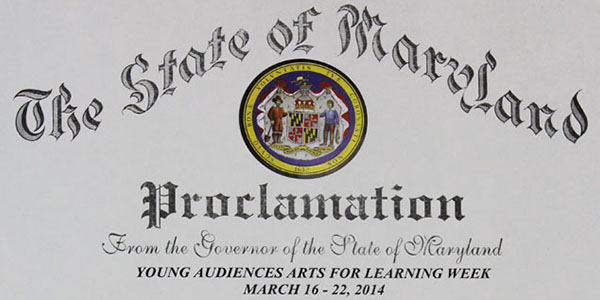
Here in Maryland, Governor Martin O’Malley has issued a proclamation that this week will also be recognized as Maryland Young Audiences Arts for Learning Week, to recognize the contributions which Young Audiences/Arts for Learning programs make in transforming the lives and education of nearly 170,000 Maryland students each year through the arts, and to promote awareness of the role that the arts play in enriching the education of students and Maryland society as a whole. You can see an image of the full proclamation or read the full text as a PDF document here.
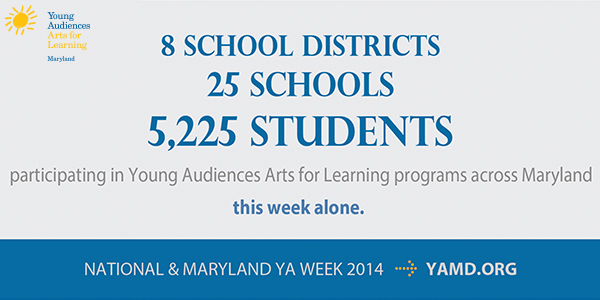
This Monday through Friday, 5,225 Maryland students will take part in a Young Audiences program, whether it be a residency, assembly performance, workshop, or early learning program. Highlights include Single Carrot Theatre’s performance of Rumpled, a fractured fairy tale version of Rumpelstiltskin that explores issues of cheating and plagiarism; Rockcreek Steel Drums’ assembly “The Birth of Steel Drum Music,” which teaches students about the history of and science behind steel drums; and Diana Saez’s smART stART professional development workshop that teaches educators how to find the natural connections between music and various subject areas.
Help us celebrate National and Maryland YA Week by joining the conversation online and spreading the word. Be sure to check back in with the Young Audiences Blog and follow us on Facebook and Twitter. Throughout the week we’ll be highlighting the amazing work of our artists and ensembles who are bringing arts learning experiences to Maryland students this week. We are also using this occasion to ask those running for governor for their views on arts education. We’ve extended the invitation to all candidates to answer two questions (posted here) and will be sharing their responses here on the Young Audiences Blog later this week.
To see more news about Maryland YA Week, click here.
Governor issues proclamation for Maryland YA Week

We are excited to announce that Governor Martin O’Malley has issued a proclamation declaring that next week, March 16 to 22, 2014, is Maryland Young Audiences Arts for Learning Week! This follows the U.S. House of Representatives Resolution, put forward by Congresswoman Louise Slaughter (D-NY 25th District), marking the same week as National Young Audiences Arts for Learning Week.
We are so appreciative of the governor for this recognition of the contributions which Young Audiences/Arts for Learning programs make in transforming the lives and education of nearly 170,000 Maryland students and educators each year through the arts, as well as the role that the arts play in enriching the education of students and Maryland society as a whole. Governor O’Malley has held his office during a tumultuous economic climate but has nevertheless always protected public funding for the arts, ensuring opportunities for students throughout our state to experience the power of the arts inside and outside of the classroom. You can see the full proclamation below or read the full text as a PDF document here.

Click image above to enlarge!
It requires strong and united leadership across all levels–from school principals and administrators, to school district-level officers, to the governor of our state–to ensure that students have the chance to experience the arts, regardless of their socioeconomic background. Governor O’Malley’s commitment is important to raising the awareness of all Maryland citizens about the critical importance the arts play in a child’s academic achievement and personal development. The arts have the unique ability to engage students in the learning of all subjects, while opening up new horizons to students, helping them develop a broader worldview and a deeper understanding of themselves, their talents, and their abilities.
Thank you, Governor O’Malley, for your continued support of Young Audiences, and your belief in the importance of arts education!
We would like to use Maryland YA Week as an opportunity to ask those running for governor for their views on arts education. We’ve extended the invitation to answer two questions (below) to all the candidates and will be posting their responses here on the Young Audiences Blog next week.
- Question 1: Maryland needs creative citizens who can imagine new possibilities for our society, think critically, solve complex problems, and collaborate effectively with others to turn these new possibilities into a reality. Young Audiences/Arts for Learning believes that the arts are an essential vehicle for building these 21st Century Skills. We are concerned both by the cuts in arts education and that our standardized testing model does not recognize the full set of capacities needed to ensure that Maryland has a thriving workforce and a civil society. As governor, how would you address our concerns?
- Question 2: Young Audiences/Arts for Learning is a nonprofit that transforms the lives and education of youth by connecting professional artists with schools and communities. Last year, Young Audiences created more than 9,000 opportunities for nearly 170,000 students and educators in 23 out of the 24 school districts (also known as Local Education Agencies), to learn in, about, and through the arts. The President’s Committee on the Arts and the Humanities made five recommendations to reinvest in arts education (included in the full report, “Reinvesting in Arts Education: Winning America’s Future Through Creative Schools”). Two of them are expanding the in-school use of teaching artists and developing the field of arts integration, the practice of using the arts as a tool to teach other academic subjects. Do you agree? If so, how would you, as governor, move these recommendations forward?
Be sure to check in with the Young Audiences Blog and follow us on Facebook and Twitter next week as we celebrate National and Maryland YA Week!
Past and present create a mural for the future
By Juernene Bass, Western High School alumna

I was very excited to take time away from work to be a part of a Young Audiences clay mural residency at my alma mater, Western High School, in October. Being a proud alumna from the Class of 1975, the program was a great example of our school motto, “Lucem Accepimus, Lucem Demus,” meaning: “We have received light, let us give forth light.” The mural project connected alumnae and current students with the rich history of our school. We had the chance to share our experiences and look back to historic articles, yearbooks, and artwork to create a piece that we could share with the whole Western community.
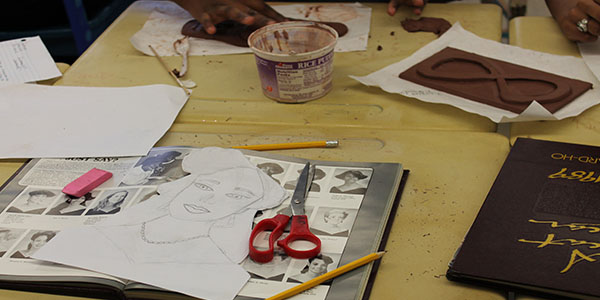
During the course of the project I was able to spend quality time interacting with my sister Westernites, grades nine through 12, as we learned from Young Audiences ceramic artist Amanda Pellerin how to create a clay mural depicting Western’s 170-year-long history of rigorous studies in arts, sciences, literature, drama, and fashion.

Amanda invited me to share my memories of Western during the 1970s with the current students. They found my reflections to be interesting, humorous, and sometimes unbelievable. I shared how Western taught me the academics that prepared me for college, the skills I needed to succeed in the workforce, and what studies I am using today to progress in my career.
As I mingled with the students and got to know them one-on-one, I learned that Western students are very creative and artistic. They were also knowledgeable about Western’s history, and many expressed great pride in attending the school. They used their imaginations and pulled their ideas together with the decades of historical facts and traced, drew, carved, and painted the clay pieces to form a magnificent treasure. Clay tiles depicted the different school buildings to illustrate the school’s various locations in Baltimore City over the years. Other clay pieces showed girls playing basketball, reading books, and graduating in cap and gown.
The clay mural project brought multiple classes of students and teachers together, giving them the opportunity to share their ideas and creativity while learning more about working with clay, Western, and each other. It allowed the students a chance to experience an art form which they may not have been exposed to before for lack of materials and time. I am sure the students enjoyed sharing this experience with one another.
Many sincere thanks to everyone who made this happen!
How song and dance changed my classroom
By Morgan Lyons, Kindergarten Teacher, William S. Baer School
When I first heard that an artist-in-residence program was coming to my school, William S. Baer, I was excited. I learned about arts integration while I was studying education in college and wanted to find a way to use the arts in my teaching, especially when I decided I wanted to teach special education. I feel that the arts are an amazing pathway, particularly for kids who might not necessarily understand the material when taught in a more traditional way. When I found out that this opportunity was being offered at my school, I was thrilled; I jumped at the opportunity.
As a relatively new teacher, I knew I wanted to integrate the arts into the curriculum in some way, I just didn’t know how. Our curriculum is structure- and task analysis-based and there did not seem to be a lot of room for the arts, but Sue Trainor, the Wolf Trap-trained artist who I worked with during the 16-session residency, taught me how to make arts integration work for our program and how it could help our students.
The program began with Sue showing me her lesson plan, which we used for our first session with students. We continued to use Sue’s plans for a few weeks. After every lesson we talked about how it went–what the high point was and what we could work on for the next session. As the program went on, it developed and changed so that I was giving more feedback and Sue was asking me more questions. I began to take more of the lead, and I grew from a consultant role on lesson plans, to writing the lesson plans with Sue, to creating the whole lesson myself. This was a great way for me to learn because I got to watch Sue, I collaborated, and then it was all me.
Sue taught me a lot of arts integration techniques that I continue to use every day in my teaching. We incorporate music and visual representation throughout the day which makes for more engaging activities. We sing through transitions and when we’re teaching new material, such as shapes, letters, colors, and numbers.
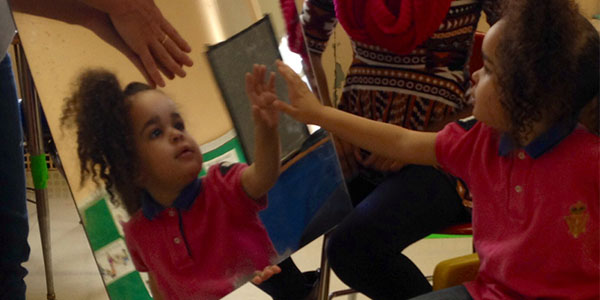
One thing Sue and I collaborated on was the idea of using a mirror with my students. My students are kindergartners with autism. Students with autism often have a skewed perception of themselves and have a hard time making a mind-body connection. The mirror’s reflection serves as an additional visual for them and provides a form of visual feedback. Rather than me just saying, “Touch your head,” they actually see themselves do that motion and make the connection.
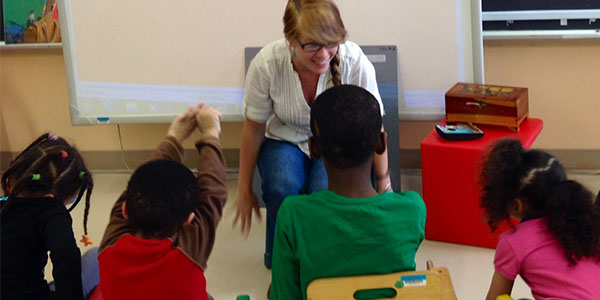
Sue also taught me what has become the go-to opening sequence for our classroom. It’s a series of two or three short songs that integrate body movement, beat, and tone. This new practice has had a huge effect on my students, but it had an enormous impact on one student in particular.
See a sample arts-integrated lesson plan created by Morgan and Sue here!
Brittany was new to our school this year. She had never had a school experience, and she was very quiet and kept to herself. Sue came in and introduced the song and movement sequence to the students, and she asked them to mirror her actions. When Sue told students to “Show me your hand,” students were asked to mirror Sue by raising their hands like she had raised hers. Brittany took to that, and she was soon asking for the song specifically by using sign language, which she had no exposure to before. Brittany was communicating and expressing her desire for the song; she was actively participating and engaging with her eyes. Had Sue not introduced this activity, Brittany may not have engaged with the group for quite some time. She has really benefited from the social lessons Sue brought to our classroom during this program.
My hope is that this experience and opportunity is available to as many teachers as possible, regardless of their academic area, because it has helped my classroom beyond words. I’m not only a personal advocate for the arts but an advocate for the arts in special needs programs.
We, as teachers, are here for the students, and whatever can benefit the students is what’s most important. My kids are changing in front of my eyes because of what I’ve learned through this residency program. Because I gave it a chance and put in a little extra planning time, I have arts-integrated activities that keep my students engaged and entertained while they are learning.
To other teachers: Give it a try and you won’t regret it.

More funding info for schools now online
In response to feedback from our school partners throughout the state, Young Audiences has expanded the resources available on its website for schools and community organizations looking for additional funding opportunities to bring valuable arts experiences to Maryland students.
In preparation for our five-year strategic planning process, Young Audiences conducted community interviews with leaders in education, arts and culture, philanthropy, business, government, and higher education. We also surveyed our current school and community organization partners, as well as those schools we have not partnered with in recent years. These surveys and interviews helped us understand what thought leaders in our field see as the biggest challenges in education and how our community views the role of the arts, artists, and Young Audiences in the education of our children.
Here were some key findings:

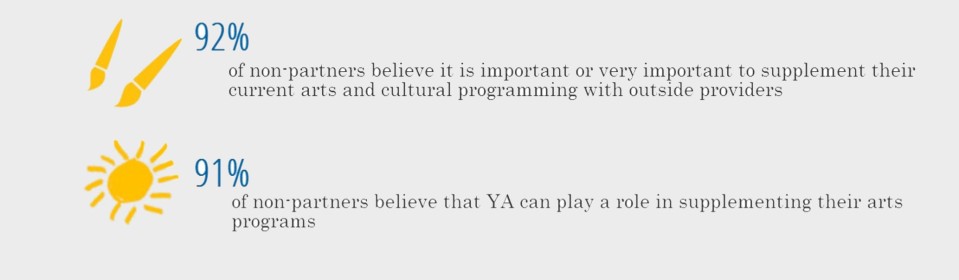
More than three-quarters of our surveyed partners said they would like to increase the amount of Young Audiences programming in their schools! Our school partners are also more aware of the array of arts-integrated programs Young Audiences offers, such as professional development workshops for educators.

While both partners and non-partners alike believe in the importance of arts-in-education programs, many schools said that barriers to the arts still exist–the most prohibitive being cuts to school budgets. Half of the surveyed schools noted that their discretionary funds for arts/cultural programs from outside providers have decreased. Many of our partners suggested that Young Audiences offer additional grant opportunity information, so we have compiled an even more comprehensive list of grants and resources for schools. Visit our website to take a look!
Despite these financial obstacles, we found a promising consensus that the arts play an important role in the education of Maryland students and in meeting educational priorities.
Young Audiences partners with several generous individuals and foundations to make our programs accessible. While many of our donors have specific sites that they wish to sponsor, if you are in need of funding to bring one of our programs to your area, please contact us at (855) 245-2787. We may be able to help.
The Artist is Present
By Kevin Adekoya, Young Audiences Development Assistant

This month, 51 artists and teachers completed their final Reflection Day of the 2013-2014 Teaching Artist Institute (TAI) Seminar. During the past five months, artist and teacher pairs have worked together to create new arts-integrated assembly and residency programs that will engage students in learning through the arts. To celebrate this accomplishment, one Young Audiences staff member shared his thoughts on TAI and what is possible when artists and classroom teachers work together to improve education.
Witnessing collaborations between artists and teachers during the Teaching Artist Institute (TAI) Seminar is like getting a behind-the-scenes look at how artists think and operate. There is a circus of artistic expression in all its forms—music, dance, theatre, and visual art—all with the power to inspire and beguile. During the past five months, carefully-crafted performances and interactive arts activities co-created by participating teachers and teaching artists have become new assembly and artist-in-residence programs for students in Maryland. Each program shows the deep personal commitment of each participant to educating students throughout the state.
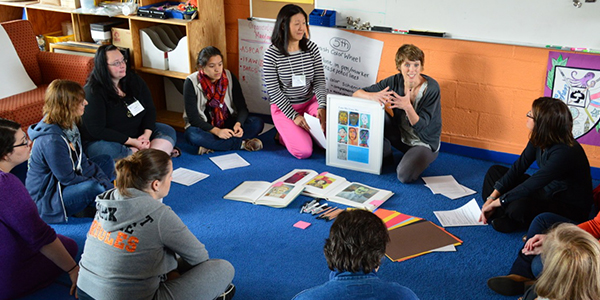
It was just a few short months ago when these artists and teachers from across the region met at City Neighbors High School for the TAI Presentation Workshop. Each artist and classroom teacher partner was present to share their plans for an arts or STEAM (Science, Technology, Engineering, Arts, and Mathematics) program. Different classrooms throughout the building were devoted to different art forms so participants could present their lesson plans to their peers for feedback. Within each room you saw groups of people listening intently as each artist and educator explained their plans and how their approach would help students connect to the curriculum in a new way.
In each room hands shot into the air to provide praise, ask questions, and suggest new ideas—all in the name of creating innovative arts-in-education programs that will inspire and excite students. Feedback, given freely between artists and educators, formed a bond that was tangible. Everyone’s focus was on finding ways to address the curriculum through the stimulating lens of the arts.
One of my favorite moments was being able to participate in a sample lesson from the residency “Culture Kingdom Time.” Jessica Smith, founder and lead teaching artist of Culture Kingdom Kids, is the Culture Queen who, through interactive song, dance, and movement, highlights historic African American role models for fifth graders. For example, Barbara Hillary, who became the first African American woman to reach both the North and South Pole at the age of 79. Or York, who, with Lewis and Clark, journeyed to unchartered western territories of the U.S. from 1804 to 1806. These stories and others connected with what students were learning in History class and focused on themes of overcoming obstacles–something all students can relate to on a personal level. Throughout her lesson, Jessica’s goal was to show children that they too could be future pioneers by remaining curious and pushing beyond their comfort zones.
Young Audiences brings together skilled professional artists and classroom teachers to create programs that combine the knowledge and expertise of both parties. By integrating the arts into the curriculum, teachers are able to engage students with curricular content and artists are able to tap into a student’s true potential. What a great experience it was to take part in!

Young Audiences has a new home!

We started 2014 off big: moving into a brand new space in the restored former tire shop at 2600 North Howard Street in Remington.
Everyone has been talking about our big move (the Baltimore Sun recently featured the new development), but we want to give you a firsthand look at what’s really going on inside our spacious new home. Check out this short virtual tour for a glimpse into our new offices, and a look back to how far we’ve come since the organization’s start in 1950!
[youtube http://www.youtube.com/watch?v=LkL6Jgh-ggE]
Come see us in person at our Open House event on Sunday, February 16, from 1 to 3 p.m. There will be Young Audiences staff and roster artists on hand to provide interactive and artistic entertainment as well as impromptu tours of the space. The whole family is welcome! RSVP here if you plan to attend. Stay updated on the schedule of events and entertainment by joining the Facebook event.
While you’re here, you can also see our neighbor (and roster ensemble) Single Carrot Theatre‘s final matinée performance of “The Flu Season” at 2:30 p.m. Learn more about the show and buy your tickets online. Discounted tickets are available for $10 by using the coupon code YAMD. Tickets are expected to sell out quickly for this final show, so please purchase your tickets early! (Please note: This particular show is best suited for theater-goers 18 years and older.)
Not able to make it on February 16? Sign up for one of our monthly On the Bright Side tours to see our new space and learn about our programs and their impact on Maryland students. You’ll get the chance to talk with one of our teaching artists, our executive director, and a member of our board, all while learning more about our work of bringing the power of the arts to Maryland students and educators.
Hope to see you soon!

Making our mark on history with art
By Nadine Elsigal, senior at Western High School

As a senior at Western High School I had the privilege of being involved in a clay mural project with Young Audiences artist Amanda Pellerin in October. Working with Ms. Amanda during the residency was such a pleasure because clay is a medium I don’t often get to use in my art classes at Western. This project was new territory for me since most of my school projects are created digitally and working with clay was an opportunity to get more hands-on. I feel that art is a crucial element to a person’s development that is often overlooked, but projects like the mural we created with Ms. Amanda really gave back to the students and allowed us a chance to create. Art is a big part of my life and I plan to pursue it as my career. This residency was also a chance for me to learn about Young Audiences, an organization that shares my belief in the importance of the arts in learning.
Seniors from both my graphic design class and a history class worked with several Western alumnae and Ms. Amanda throughout the project. We decided to create a visual timeline of our school’s history to celebrate Western’s 170th anniversary this year. I knew little about our school’s rich history at the start of the project. We worked as a team to delve into past yearbooks and brainstorm with alumnae to decide on the imagery we would include in the final piece.
I decided to recreate our senior class T-shirt design in my clay tile to represent current Western students. Including a symbol of our class in the mural was a chance to leave behind a piece of the Class of 2014 within an artwork that will hang at our school for years to come.

View all three pieces of the finished mural, as well as photos of its creation, online.
As hard as it is to choose my favorite part of the residency, I think I enjoyed hanging the finished mural the most. There isn’t a better feeling than seeing work you have created put on display. It made me realize that I had done it–I overcame the challenges of the project and created something that current and future students will enjoy. I feel proud to have been a part of this residency and to have successfully completed such a large project that can be shared by my school community.
At the start of the residency I was excited–I thought the project would be fun and a great opportunity to leave our mark on Western. Now that the mural is complete and installed I feel accomplished. As I finish my last year at Western, I will graduate knowing that I added to my school’s long history.