


Blog

In Memoriam: Beth Braden

By Jason A. Dykstra, Director of Accountability & Testing, Instructional Data Division, Anne Arundel County Public Schools, and Former Principal of Southern Middle School
On April 30, 2014, Beth Braden, an outstanding educator, champion of arts integration, mentor to teaching artists, and great friend to Young Audiences, passed away. Thank you, Beth, for your passion, energy, and commitment to providing an arts-rich education to all students. Your legacy will continue through the many teachers, artists, and students you have influenced. You will be greatly missed.
“Hi Boss!” That was the typical greeting I would get at any given moment by Beth Braden during my five years as principal of Southern Middle School. She would have a smile on her face, a spring in her step, and she would simply move on with whatever she was busy doing at the time. That greeting, as it turned out, was more than a “Hi.” It was a sign of confidence that we are going to have a good day—that we are getting the job done—and that we are making a difference today. All in that one little phrase: “Hi Boss.” I think it was the way she said it that made me understand.
Of course, I am not sure that I realized that until after I had been working with Ms. Braden for a year and learned how special she was. For those who have had the amazing pleasure of working with Ms. Braden, we saw first-hand her passion for teaching, her love of students, and her dedication to making a difference every day. It would be unforgivable to forget her unwavering advocacy of arts integration. It was actually hard to have a conversation with Ms. Braden where she would not find a way to mention how the arts could help students. Even discussing eighth grade discipline referrals, she would remind us that more exposure to the arts would help those students. That’s it—we need more assemblies and experiences!
How do we possibly measure Ms. Braden’s contributions and importance to Southern Middle? Not only can it not be measured, her influence will live on at Southern Middle School for years to come. Her school spirit and commitment to the cultural arts will be remembered by all. Did I really have a choice but to agree to a slam poetry assembly? Ms. Braden reassured me that not only would the assembly go well, but our students would really benefit from the experience. It was no surprise that she was right on both points.
We all have very special memories with Beth Braden—whether it is amazing improv performances by the Drama Club & Zip Zap Zop, steel drums, African dance, field trips, dressing up for spirit days and Halloween, celebrating Dr. Seuss’ birthday and Emily Dickinson, lively classroom debates, Artful Thinking activities, cool projects, and, most importantly, seeing all of the arts showcased at the largest and best cultural arts event at the middle school level—The Arts Are Everywhere Gala. Those traditions will no doubt continue and we can thank Beth Braden for teaching us the value of the arts and how new and different experiences enhance our lives.
What makes Beth Braden truly special and unique, however, was her work in the classroom. Every day was 100%. Every day was an opportunity to reach a student. Every day was a chance to make a connection. Every day was designed to be a success. The result? Every day was the epitome of trying to make a difference. At times it could seem unconventional, but she never lost hope and was always willing to give a student another chance to be successful and they respected Ms. Braden for it. The biggest compliment I could possibly give is that I would have loved for both of my children to have had Beth Braden as their teacher. The great news is that thousands of students did have the opportunity to benefit from her passion, creativity, knowledge, and many talents. In addition, we got to work side-by-side with a fantastic educator. We were all very fortunate and we know it!
Both in and out of the classroom, Ms. Braden really just wanted her students to think outside of their box, to explore themselves through reading, writing, and the arts, and to communicate well-thought-out ideas and opinions. What would Ms. Braden want from us today? For us to think out of the box about the potential of our amazing profession, to explore more ways to create positive change in school, and to communicate all of our great ideas and opinions with each other. That is an easy and wonderful way to honor Beth Braden and her many contributions to education and our lives.
Sometimes we don’t have to say much to make a difference in a person’s life—“Hi Boss”—it was just the way she said it that made me understand. So thanks to you Ms. Braden—we are going to have many good days, we are going to get the job done, and there is no doubt that we are going to make a difference! “You Rock!”
Watch a short video that features Beth explaining why the arts are critical in every classroom.

Working to bring the arts to every student

By Dr. Sherrie Norwitz, Instrumental String Music Teacher, Thomas Jefferson Elementary Middle
Art and aesthetics are crucial to the foundation of society. Arts education provides children the opportunity to be exposed to–and develop their own–appreciation of beauty in their world. Art is a way to transmit the values of the society. Through the arts, children learn about their community, helping to provide them with a context for their lives within their communities, and become active participants in helping to create their communities. Arts experiences open doors to children, allowing them to say, “I am touched by this. I am a part of this beauty. I created this. I shared my creation. This has meaning to me.”
Sequential education in the arts is a crucial component in a child’s education. Learning about and through the arts gives students ownership of skills and knowledge to become active participants in society through creative expression and communication.
It is important to me for students to experience the integration of the arts across the curriculum and the varying natural connections that are inherent between the arts and their core curriculum subjects. This arts integration approach supports the learning of core curriculum subjects, reaches a wide-range of learners, provides authentic real world experiences that directly involve students in the act of creating, provides opportunities for collaboration, and supports the development of 21st Century Skills through the Common Core and Career Ready Standards.
Through our partnerships with Arts Every Day and Young Audiences, our school community is finding its way in creating a comprehensive arts integration program. With the support of our principal, Ms. Henry, we feel that we have a very strong foundation for our program’s growth and development.
This year we began by extending the arts-integrated approach to learning beyond the artist-in-residence program which we had previously brought to our students. Working with Young Audiences, we created a Resident Teaching Artist position for the year to allow for the continued presence of a teaching artist within our school. Our Resident Teaching Artist, Young Audiences artist Kwame Opare, performed with his ensemble, DishiBem G.R.O.W. during school-wide assemblies, and provided workshops to fifth- through eighth-grade students. Kwame also provided our teachers professional development in arts integration to help answer their questions, provide guidance, calm apprehensions, and worked with teachers during collaborative teaching days to bring arts integration directly to the students in their classrooms.
Partnering with Young Audiences to provide such a variety of programs throughout the year ensured that we incorporated arts integration best practices and included all of our grade levels–preschool to grade 8–in these art experiences. Being an International Baccalaureate School (IB) also helped support our way forward in the interdisciplinary learning of arts integration.
Arts integration and arts-enhanced learning is happening in many ways in different classes. Among our activities, students have drawn Grecian vases as part of their Ancient Civilizations unit, they have dramatized stories through dance, applied music notation to learning fractions, used music to help understand number columns, made connections between literature and music while dancing “The Nutcracker,” and created a paper Freedom Quilt.
We have developed a rhythm of arts integration at Thomas Jefferson. We are working to create an environment where everywhere you look, the arts are happening, where the arts are for everyone at the school and where connections with the arts can be made throughout a student’s day. Having a sense of continuity of arts experiences helps create a feeling of expectation of such experiences for both students and teachers. There is a developing sense school-wide that the arts and arts integration “is what we do.” We look to have the arts not as “special” but as a continuing presence in our daily school life, where learning can take place through the arts. There is something for everyone–for students in all grades covering a variety of subjects, and for teachers to feel supported with our teaching artists and our partnerships with Arts Every Day and Young Audiences.
Artistic energy invigorates the school environment, developing our professional skills as teachers and invigorating learning for students.

The Intersection of Art and Science

Young Audiences’ artist roster includes professional teaching artists who are both highly skilled in their art form and passionate about engaging students in learning through their art. Our artists are experts at highlighting the natural connections between their art and the curriculum, including everything from world history to math to literature. Every Young Audiences program both shares skills specific to dance, music, theatre, or visual arts and offers students the opportunity to learn about other curricular subjects in a new way.
For Young Audiences artist Kevin Martin, art links directly to science. Kevin is an artist who specializes in building and playing the steel drum, an instrument that requires a vast amount of scientific knowledge in its production. Kevin was recently interviewed in Trumpf Express, a magazine dedicated to sheet metal processing, for his scientific expertise. In the article, Kevin points to studying the carbon content and thickness of the metal as well as balancing strength and flexibility as some of the essential aspects of creating a drum.
Kevin brings steel drum music into schools through assembly performances and hands-on workshops with students and educators. During residency programs like the Steel Drum Experience and professional development programs for educators, such as Steel Drums in the Classroom and The Physics of Steel Drums, Kevin brings dozens of steel drums into the classroom so students and teachers can try their hand at playing the instrument and experience how physics concepts play a role in the sound of the drum. As Trumpf Express notes, “last year, he visited 100 schools with up to 100 students at a time, and thanks [Young Audiences], Kevin is able to provide many with drums of their own.”
Though Kevin is accomplished in both the science side of production and the artistic side of playing, when asked what he loves to do most, Kevin responded, “I love all of it.”
Read the full article by clicking on the image below.
![KM2[1]](http://youngaudiencesmd.files.wordpress.com/2014/05/km21.jpg)
Watch Kevin speak about his passion for steel drums at TEDxChesterRiver here.
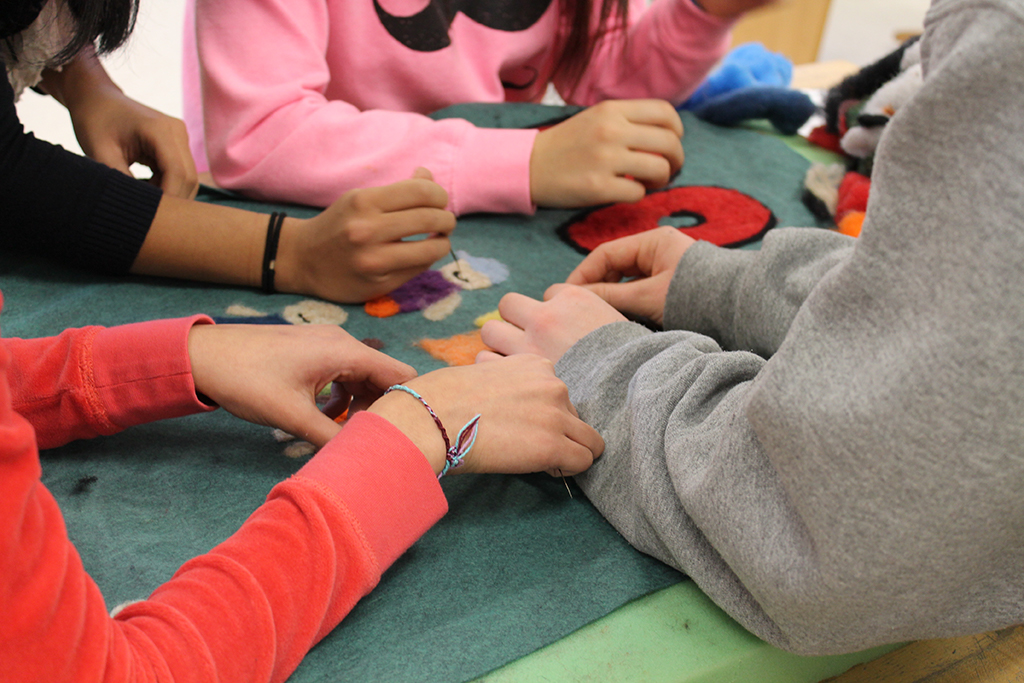
Donor Spotlight: Blaustein Philanthropic Group
Young Audiences programs teach students about teamwork, tap into their creativity and imagination, and increase their understanding of other cultures through performances and artist-in-residence programs. We believe it is critical to share these opportunities with all students in Maryland.
In 2012-2013, Young Audiences reserved $102,847 of contributed funds to provide deeply-discounted programs for special needs and Title I schools in Baltimore City and rural Maryland counties through the Access for All Initiative.
To expand access in the city, public and private funds were matched with funds from the Baltimore City school district and the Maryland State Arts Council, which allowed us to serve more than 14,500 youth in 53 high-need schools, where on average 87.5 percent of the student body is eligible for free and reduced-price meals.
Blaustein Philanthropic Group, one of the contributors to this initiative, has significantly increased its support of Young Audiences to help lower the financial barrier to the arts.
Lara Hall, Blaustein Philanthropic Group program officer, said that supporting Young Audiences and Access for All allows the group to meet their goals of increasing their support of educational arts experiences in Baltimore City.
“The Blaustein family has a long history as patrons of the arts,” Lara said. “As the younger generation has come into leadership roles at the foundation, they have posed the question: How do we use the arts as a spark to make sure kids have the best educational experience in Baltimore?”
Blaustein chose Young Audiences as the strongest nonprofit candidate to accomplish this work.
“Supporting Young Audiences’ Access for All Initiative is the most efficient way for Blaustein Philanthropic Group to support more arts education in the city,” Lara said.
Learn more about the Access for All Initiative.
Read about the work Young Audiences supporters have helped make possible in our 2013 Annual Report.

Donor Spotlight: Jen and Michael Sachs
As a former preschool and kindergarten teacher, Jen Sachs often used music and theatre to engage her students. Although Jen lacked formal training in the arts or arts integration, she sang and used costumes and characters to encourage her students to participate in lessons. These small changes made a big impact.
“The benefits for my students were amazing,” Jen said. “They learned and obtained concepts quicker. They were able to express themselves better. They loved coming to school and appreciated new experiences.”
Seeing the impact of the arts on students is one of the reasons Jen was drawn to Young Audiences and became a Sunburst Society member in 2010.
 Jen is particularly excited that Young Audiences has expanded into early learning classrooms as the Maryland sponsor of the Wolf Trap Institute’s Early Learning Through the Arts.
“The arts programs that include music, visual arts, and theatre are extremely important for developing minds,” Jen said. “Children are learning as they are doing. Whether they are building vocabulary through music and theatre or demonstrating the acquisition of knowledge through dance and movement—they are gaining vital skills for life and learning.”
Using Wolf Trap’s respected residency model, Young Audiences is bringing programs to Baltimore City preschool and kindergarten classrooms by off-setting the cost with community support.
“Low-income students often have limited opportunities to experience the arts in school,” Jen said. “Young Audiences’ programs fill this void and do more than teach students how to sing, act, dance, or play an instrument—they teach them to believe in themselves.”
Read about the work Young Audiences supporters have helped make possible in our 2013 Annual Report.

Donor Spotlight: Amanda Pellerin
“Wow, this is the first time I have ever felt artistic!”
Young Audiences ceramic artist Amanda Pellerin overheard this proclamation from a student during an artist-in-residence program. The student made this statement to no one in particular, but Amanda asked him to explain.
“He said he never thought he could do art, so he had never opted to take an arts class before,” Amanda said.
Instances like these, when the arts change how a student thinks of him or herself, are the reason why Amanda is committed to sharing her art and skills with students. “I work for those moments when kids exclaim to the world: I get it. I’m special. This is making me see myself in a different way,” Amanda said.
Amanda partners with Young Audiences to bring arts experiences to Maryland students—regardless of the school’s budget limitations. Young Audiences’ Access for All Initiative was created to lower the financial barrier for Title I Baltimore City Public Schools interested in bringing a Young Audiences program to their students.
“I live in Baltimore and personally feel really good when I’m working on a residency that is funded by Access for All,” Amanda said. “I’m directly affecting my community—I feel a special pride.”
This pride has propelled Amanda to donate to Young Audiences and join the many community members who invest in our work.
“I believe in the mission,” Amanda said. “As I’ve watched Young Audiences grow, my work has grown exponentially. I’ve realized that it’s very satisfying for me to share my skills and my knowledge with someone—to see the light go on inside of someone’s head as they turn an idea into a clay project.”
Read about the work Young Audiences supporters have helped make possible in our 2013 Annual Report.

Allowing students space to breathe and grow through theatre

By Sherion Cosby, Theatre and Television Production teacher at Westland Middle School
Middle school is an awkward stage when you don’t know who you are sometimes. I believe that theatre has a special ability that allows students room to breathe and learn about themselves. So many of my middle school students—even some of my high school students—need this space. They are body-conscious and hair-conscious and wondering, “Am I good enough?” and, “Do I fit in this clique?” But when they step on stage, theatre helps them let go of these worries.
Young Audiences ensemble Synetic Theater recently completed a residency at Westland Middle and it truly was an awesome experience for the students to see role models who exhibit a carefree but committed attitude in theatre. The actors from Synetic showed my students that they can step out of themselves and go ahead and do their thing. It brought them so much freedom.
I knew of Young Audiences and reached out to them because I knew I had a wonderful group of eighth graders who I wanted to expose to another level of theatre through a residency program. I wanted them to look at theatre the way professional actors do and experience different methods and styles. I also wanted to include the sixth and seventh graders in the residency because I was hoping to whet their appetite for theatre. I wanted to build that desire to participate in theatre at school. I wanted them to see that it is not just fun—that there is skill involved.
Synetic taught students that they should think of their bodies as their acting instruments and introduced theatre exercises that focused on warming up the body. Students no longer saw acting as just walking on stage and reciting lines. With Synetic, they had to think of warming up the neck and the head and the eyes and the legs. During these exercises, students also practiced concentration and mindfulness.

See more photos from the residency here!
Synetic worked with students on movement and characterization. I wanted my students to have the latitude and freedom to be someone other than themselves on stage. It is hard to overcome the fear of rejection from their peers when trying something new, but Synetic was able to pull them from where they were to a new place. As a teacher, it gave me what I needed in terms of getting students to step outside themselves. Synetic made my job so much easier.
At the start of the residency, I was concerned about one student, Matthew*, who is a talented athlete. I worried that he would be hard to engage in the program because he did not identify himself as an actor. During the program I saw Matthew change when he saw the male actors from Synetic demonstrating the theatre exercises. The actors also singled him out with praise during the various activities, saying, “That is really good. I like that. Keep doing that.” Matthew has totally changed since this experience. He can’t wait to get to theatre class now. He has come to see himself in a new light—he is not just an athlete but an actor, too.
During the residency culminating event, the sixth, seventh, and eighth graders all had a chance to demonstrate what they had been working on with Synetic in front of their classmates and parents. After they saw the feedback and applause from the audience, my students walked out of the media center like they had just delivered the best performance in the world. They were thrilled with what they accomplished in such a short period of time.
In theatre class students build relationships and bonds. They know that it is an environment where they can truly be themselves. They can express themselves and no one will judge them. They can be silly and ridiculous, and no idea is crazy or dumb. Because of this residency we were able to expose more students to the power of theatre, especially those who may not have opted to take a theatre class before this experience.
It is great to be able to rely on resources and partners like Young Audiences to reach the goals that you have in mind for your students, and that is exactly what happened with this residency. It took my kids to a place where they are comfortable being on the stage and outside of themselves.
Learn more about Synetic Theater and their program offerings here.
*Names of students have been changed to protect their privacy.

Celebrate Earth Day with songs by students

[soundcloud url=”https://api.soundcloud.com/playlists/31529819″ params=”auto_play=false&hide_related=false&visual=true” width=”100%” height=”450″ iframe=”true” /]
You can also find the songs on Soundcloud. Please share them with your networks in celebration of Earth Day!
Looking for an arts program that connects to environmental science for your students? Use Young Audiences’ searchable program database to easily find programs that align with specific Curriculum Connections.

Passing on a Baltimorean art tradition

By Elaine Eff, folklorist, author of “The Painted Screens of Baltimore: An Urban Folk Art Revealed,” and co-founder of the Painted Screen Society
The recent Young Audiences artist-in-residence at the Baltimore Design School was one of those serendipitous and wonderful coincidences you don’t often come across. John Iampieri, a member of the Painted Screen Society who we’ve been working with for a number of years, has taught all over Maryland through his work with Young Audiences. When he announced that there was going to be a residency at the school, it was like all of our dreams come true!
The Painted Screen Society has been involved in residencies since the society began in 1985 for the purpose of keeping rowhouse arts alive in Baltimore. The whole idea behind the society is to get the art form into the hands of people who are more likely to carry it on or would benefit from knowledge of the indigenous tradition. Nothing could be more useful than to maintain it in the hands of Baltimore students who are being schooled to be artistic in some way.
I wanted to make sure that the students working with John would get the full experience of the history of painted screens, so they came to MICA, and together we toured the recent exhibit, Picture Windows: The Painted Screens of Baltimore and Beyond (Meyerhoff Gallery, December 13, 2013 to March 16, 2014), which was a three-dimensional embodiment of everything in my book, “The Painted Screens of Baltimore: An Urban Folk Art Revealed,” and focused on passing the tradition on. The students also saw the documentary film “The Screen Painters” and got to see the painters in action. They learned that painted screens were not just meant to be beautiful, but were also a practical innovation, used in private homes to discourage individuals from seeing into windows while still allowing those inside to see out. I wanted students to understand that this is something that is relevant to their lives and their environments, because this is a Baltimorean art form–born here, created here, consumed here, and beloved here for many years.
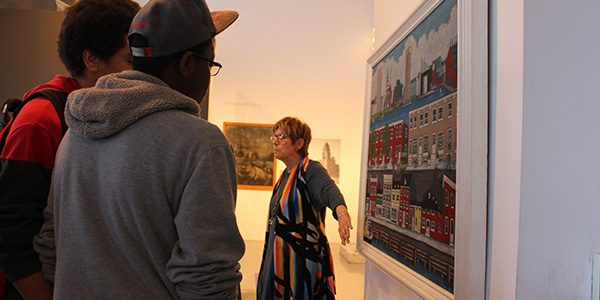
Anybody who is able to get one more person to understand the value of painted screens in his or her own community is important, but John just happens to be an incredibly organized, thoughtful, and patient teacher. He has the right combination of creative ideas because he thinks in terms of the group working together as opposed to individuals creating single products.
John thinks beyond the screen. He isn’t thinking merely about putting an image on your window; he’s thinking about images that can be adapted to all sorts of applications, and the fact that he thinks big, in terms of banners and murals, brings him right into the intersection of the new breed of screen painters and the whole digital evolution. His approach allows many hands to collaborate to make large screens that can have a variety of installations. With his help, the students at the Baltimore Design School came together with a single purpose, which produced really impressive results that they can be proud of.
What was really important throughout the project was that the students realized that everything was up to them. They chose the subjects and the teams. They then learned about design, color, and new materials they never would have heard of. They were also learning to work as a group. Learning to do something in a prescribed manner sometimes trumps being an independent artist—a status they may not be ready for.
I’m hoping that, after this project, some of them say, “Wow, I can do that!” and will go home and add value to their own homes. I hope the students’ eyes have been opened to possibilities they didn’t even know about and also to a really important traditional art that is native to their city, one that couldn’t be more relevant to the rowhouses they live in and the lives that they lead. I’m hoping that connections were made and that one day they’ll say, “I remember that.” I hope they some will keep the tradition alive, because without people who know and value them, traditions do not endure.
Part of the beauty of this art form is that there’s always been an ebb and a flow. Painted screens have been everywhere and nowhere in the course of a hundred years, and my sense is that they’ll be back, and they’ll be in another form, and let’s hope that Young Audiences continues to play a role.
Read more about John Iampieri and his visual arts residency program here.

Bomani promotes the arts during morning announcements
Young Audiences artist and Hip Hop poet Bomani took to the airwaves during the morning announcements at William Paca/Old Post Road Elementary in Harford County to build excitement for upcoming SMART Days at the school. SMART Days are a key component of Young Audiences’ ongoing SMART program in all five Harford County Title I schools. Each school has one SMART day per week, all school year. On SMART days, a teaching artist and an arts integration specialist spend the entire day with teachers and students. Teaching artist and teachers collaboratively plan, teach, and reflect on arts-integrated lessons. The lessons are always aligned with the College and Career Ready Standards and focused on skills and concepts students struggle with most, such as fractions or figurative language skills.
This “Hip Hop Public Service Announcement” highlights Bomani’s skills as a poet and “shout outs” for teachers who are arts integration leaders at the school. Listen to the full announcement here:
[soundcloud url=”https://api.soundcloud.com/tracks/143057728″ params=”auto_play=false&hide_related=false&visual=true” width=”100%” height=”450″ iframe=”true” /]
The SMART program, formed in partnership with the Harford County Public Schools Title I Office, aims to help improve teacher practice through arts-integrated embedded professional development for teachers. At the heart of the program is the collaboration between teaching artists and teachers. The education expert and artistic expert work together to re-envision how to teach content in a way that challenges, motivates, and inspires students to learn more.
Learn more about the SMART program here.
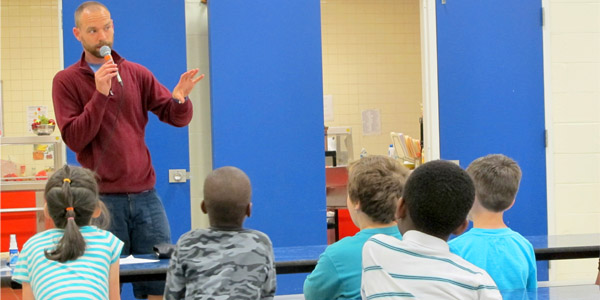
Teaching Grit through the Arts
By Katie Keddell, Young Audiences/Arts for Learning Office and Volunteer Manager

This story was originally posted as a part of the Americans for the Arts Teaching Artist Blog Salon in March 2014. See all of the salon posts here.
On Saturday, February 1, I had the wonderful opportunity to watch Young Audiences/Arts for Learning teaching artist, Max Bent, work. We were not in a classroom and we were not in an official Young Audiences program at a school or community organization. Instead, we were joining our neighbors, Single Carrot Theatre, in welcoming the neighborhood to our new home at 2600 North Howard Street in Baltimore. Max was offering a musical demonstration to anyone who walked in to say hello and hear more about Young Audiences. After an hour of recording sounds visitors played on a small steel drum and various other eclectic instruments, Max created a symphony of sounds by layering impromptu measures of four beats on top of each other. As he taught, I was struck by one phrase he kept repeating: “We have to re-harness the things that happen by accident.” I instantly connected this idea to my research as a graduate student.
As we talk about the young people in our state and across the country, one major trend is the desire to teach our students what one popular researcher calls, “Grit.” As defined by TED Talk speaker Angela Lee Duckworth:
“Grit is sticking with your future—day in, day out, not just for the week, not just for the month, but for years—and working really hard to make that future a reality.”
Passing a paper test with a singular focus cannot teach this tenacity, but overcoming a challenge does. In 10 minutes, I saw Max demonstrate how he teaches grit through the arts-integrated programs he brings to Maryland schools. Our guests saw the value of sticking with the exercise themselves and heard the physical evidence created by their instruments. Each individual walked away with a small but powerful example of success through staying with something despite no prior knowledge of the steel drum or the technology Max was using to record and layer sounds
Before Max joined Young Audiences, he did not see a connection between his art and the school curriculum. Max applied to participate in the Teaching Artist Institute (TAI), a training program for artists developed by Young Audiences in partnership with Arts Education in Maryland Schools Alliance (AEMS) and the Maryland State Arts Council (MSAC), to deepen his knowledge of how the arts can naturally connect to the curriculum and engage students in learning. After successfully completing the program, Max now has a collection of lessons that connect beatboxing and music to a multitude of subjects, such as probability, fractions, graphing, and phonics.
That’s what excites me most about Young Audiences: the belief in arts integration. For me, it’s not only about teaching the future generation aesthetic appreciation, it’s also about finding the ways that divergent thinking and practical application speak to the future of what our children learn and believe they can achieve. It’s about giving all students a chance to explore their talents, giving them a safe environment to take risks, to make mistakes, to achieve, and to persevere. It’s about teaching grit.
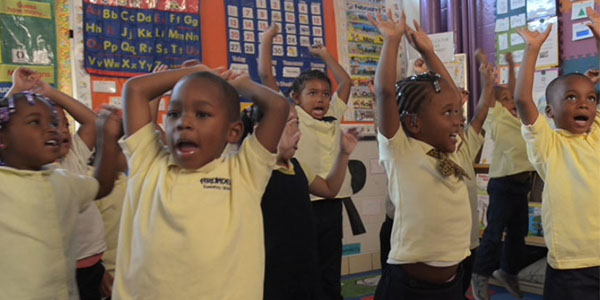
Why the arts make the difference
By Stacie Sanders Evans, Young Audiences/Arts for Learning Executive Director

I recently took a foundation representative to see what our Maryland Wolf Trap Early Learning Through the Arts program looks like when an artist is in a preschool classroom.
Afterward the representative asked me a question that has stuck with me: “Why does this program really matter–what real difference is it going to make for kids?”
If you are like me, life hits you weeks later and you always have a better answer when the moment has long passed. I have my answer now.
Arts-integrated education programs, like the residencies offered through Maryland Wolf Trap, matter to Christopher. After we observed the lesson, the teacher, Ms. Miles, and teaching artist and musician Sue Trainor debriefed, discussing what worked (and didn’t) during that day’s lesson. In this session, Ms. Miles had taken the lead in incorporating music and drama into the literacy lesson with support from Sue. Both Sue and Ms. Miles mentioned what a big moment it was for Christopher to fully participate in the lesson centered on the book the class was reading.
Christopher had played the part of the goat during the reading, and held his friends’ hands while traveling across the room singing. When the children were asked to sit, he joined his friends on the carpet to reflect on the elements of the lesson they liked the best using the song prompt: “That’s what I like, uh-huh, that’s what I like, uh-huh.” Each student was asked to show what they had liked about the lesson by adding a movement to the end of the song. Christopher stayed with the group and listened intently as his peers shared.
I actually didn’t know who Ms. Miles was referring to because Christopher looked no different from any other student in the class. But today had been an important step for Christopher, who often finds it difficult to pay attention, and wanders away from the group when he is distracted by the task at hand. Today Christopher was engaged and the lesson kept his interest. In these formative years, children develop a strong sense of how they feel about learning, school, and themselves. These impressions can hinder or fuel a child’s confidence and achievement for years to come. Today we were the fuel.
This program matters to Ms. Miles who said tearfully that Christopher’s success was the moment she lived for as a teacher. “These shining moments keep you going,” she said.
Ms. Miles is an incredibly gifted teacher whose dedication to her students is evident from the moment you walk into her classroom. But, like every great teacher, she is hungry for these moments–and this is what motivated her to bring this 16-session Wolf Trap residency program into her classroom and fully take advantage of the embedded professional development.
Ms. Miles now has more confidence and skill in using singing, rhythm, and creative drama to actively engage children in stories. She has an arsenal of arts strategies that keep 25 little bodies and minds fully engaged in her lessons. Instead of a simple read aloud of a book she is using the arts to bring these stories to life.
This program matters to all the children in the classroom. What Ms. Miles and other participating teachers find is that these kinds of arts-integrated lessons stick–children are better able to recall the sequence of events and characters of the story, comprehend the story, and recognize the new words being introduced in the story. More importantly, students in our program have an increased interest in books and stories. All of these skills are essential to school readiness.
Fortunately, these moments also matter to the foundation who joined us in the classroom, which recently granted us an award that will make it possible for us to reach seven additional high-need Baltimore City preschool classrooms and 175 more early learners through the arts.
Learn more about the Maryland Wolf Trap Early Learning Through the Arts program here.